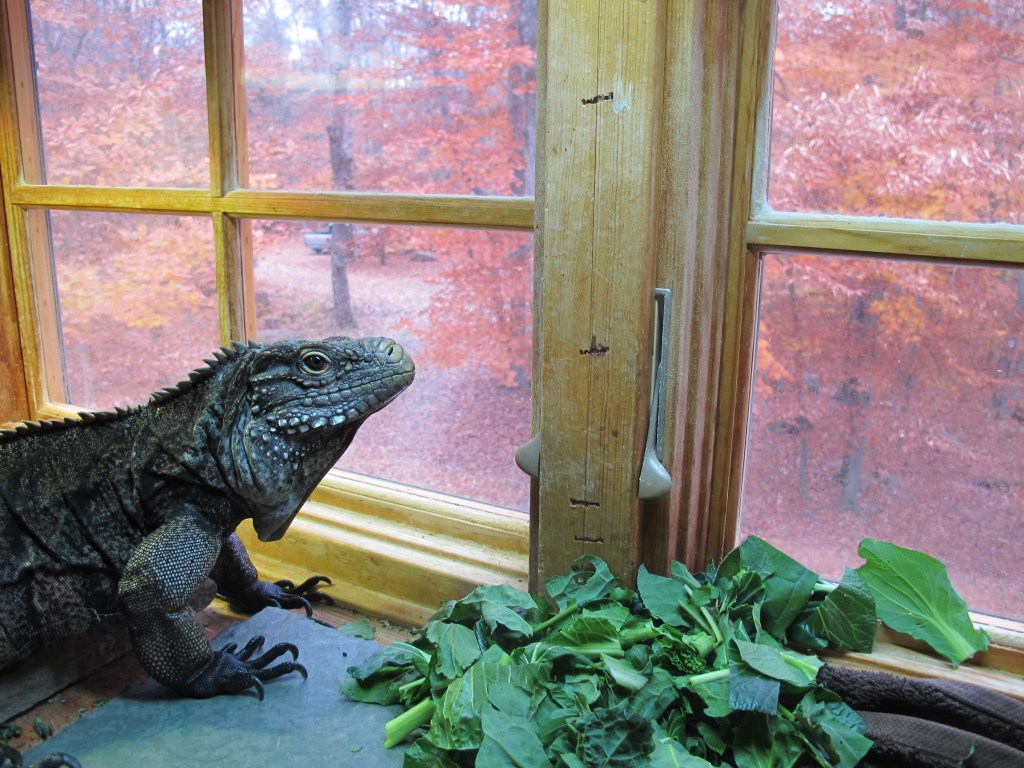
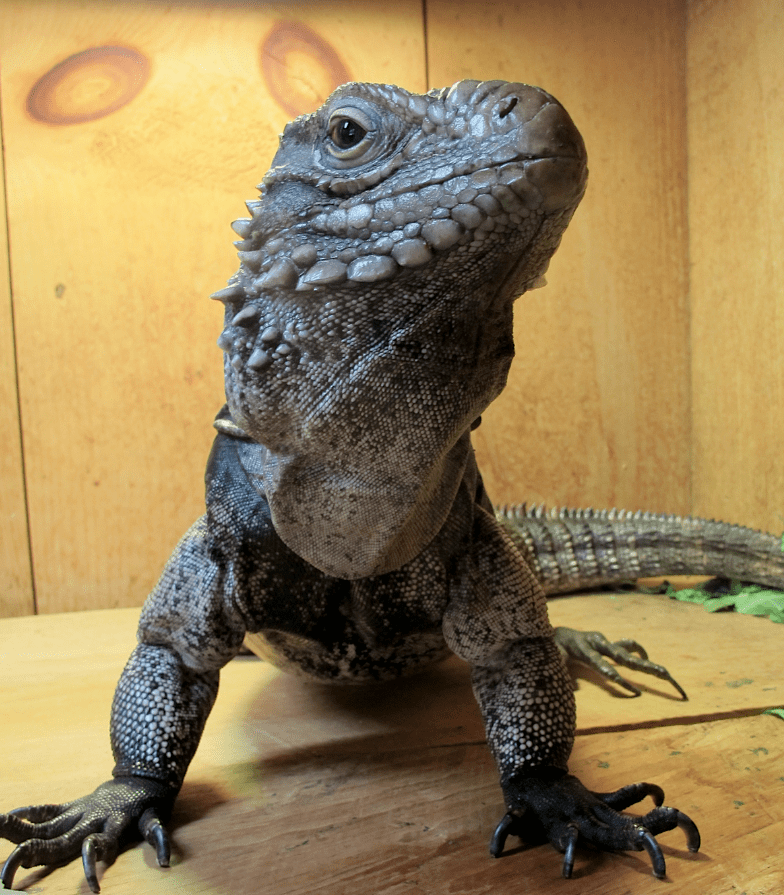
Iguana Family
Many years ago, in the Florida Keys, my friend Robert Ehrig bought a couple acres of tropical scrub forest and set about building a house on posts, to be safer during hurricanes and floods. When the trees he planted grew up, it would be like living in a tree house. Water came from a cistern in the oolitic limestone underground, and he put in a composting toilet and electricity. Bob’s love for and knowledge of the plants and animals of Florida and the Caribbean inspired me. He was creating a home where he could live closely with wildlife and nature. Over time he restored that patch of land to what it was before Europeans came. He brought in tiny cacti thought to be extinct, trees and orchids and bromeliads native to the keys. Anole lizards skittered up and down the trees. Hummingbirds sipped from the bromeliads and orchids. In the middle of this paradise, he built pens and cages for lizards –big ones, West Indian rock iguanas.
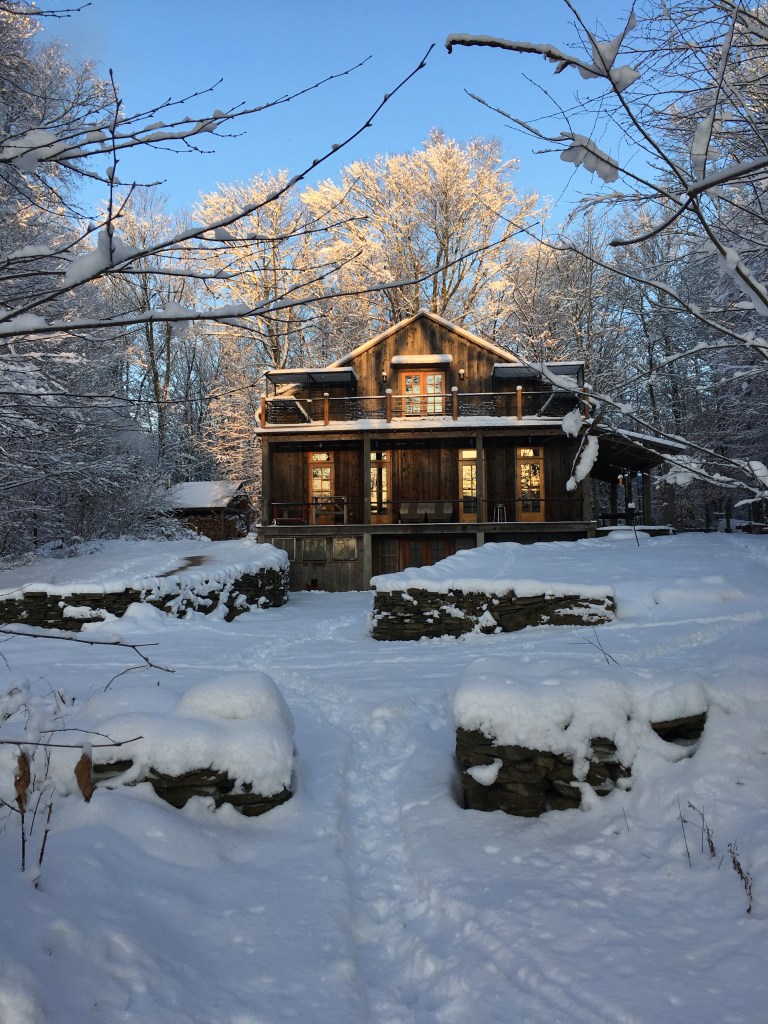
I’d come to Bob’s place in 1993 to write about his iguanas for school. That was when I met the rhino iguana Mao (see my Home page). In 2001 Mark and I drove down to see about starting our iguana family. Were we crazy to try to keep tropical lizards in a barn in the Catskills?
Before our trip to Florida we prepared a nursery for baby iguanas in our bedroom. We took out the glass in the window and put in special Plexiglas called Solacryl that let in the full spectrum of the sun’s rays plus we set up full spectrum basking lights and plugged them into an automatic timer to create a day/night cycle. Why is all that lighting so important? Iguanas are tetrachromats, which means that they have a fourth set of cone cells in their eyes. In ultraviolet light, they can see variations in color that we cannot. Without the right light, their bones and organs will not grow properly, and their world is dim and depressing. I check the mercury vapor basking bulbs with a Solarmeter. If the UVB output goes below 70 microwatts per square centimeter, I change the bulb.
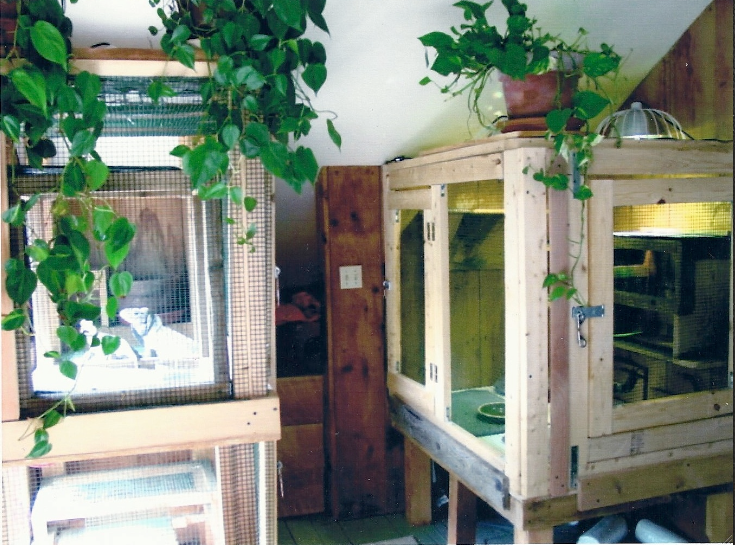
We built a tall cage around the window with a basking shelf inside, so the lizards could be in the upper part. We put in a wooden birdhouse for hiding, a heat mat, branches for climbing, and a water bowl. This picture is when Ava and Emo arrived, and the lizards needed more room.
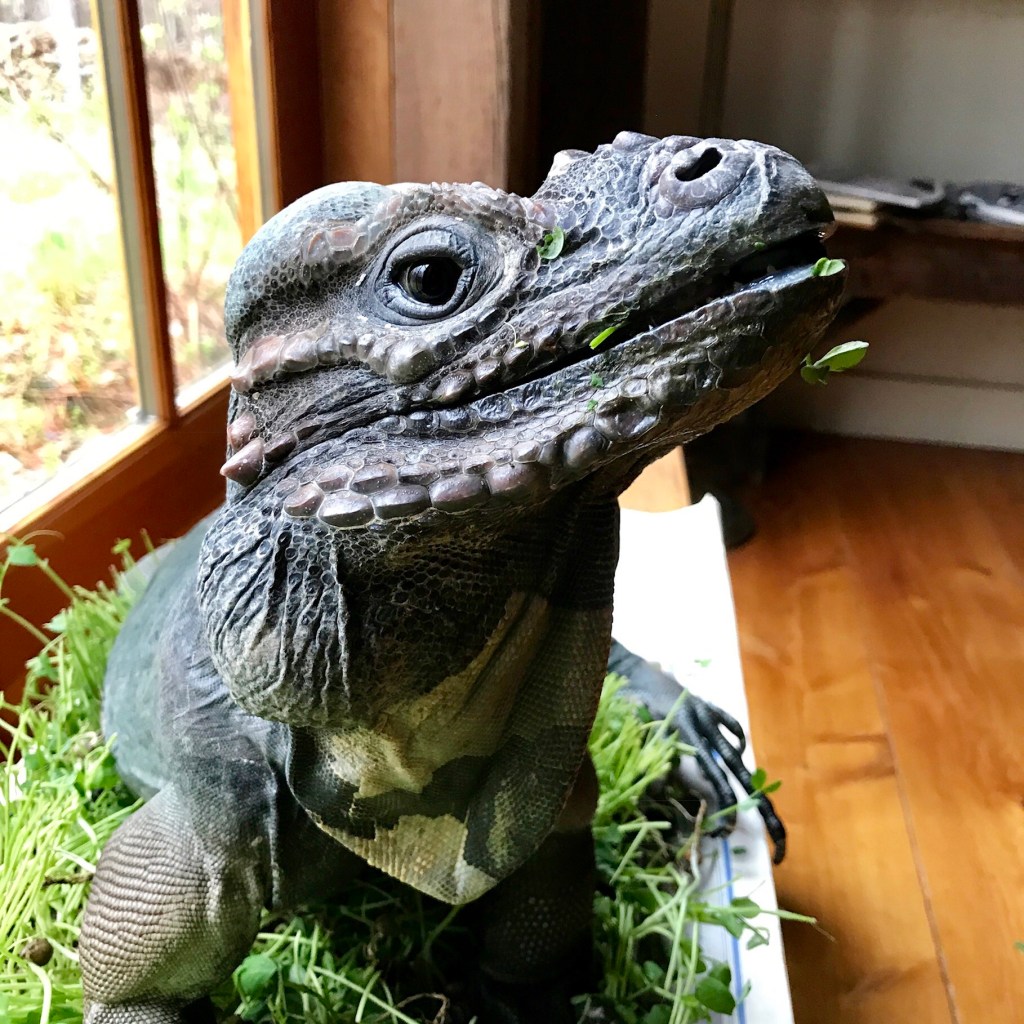
When we arrived at Bob’s place only one baby rhinoceros iguana was left from the year’s hatchlings: Mao’s grandson, Sebastian. It was destiny! We also chose two baby Cuban iguanas and named them Luna and Che. Two years later, the young rhino iguanas Ava and Emo arrived by DHL express overnight.
When Sebastian was a baby
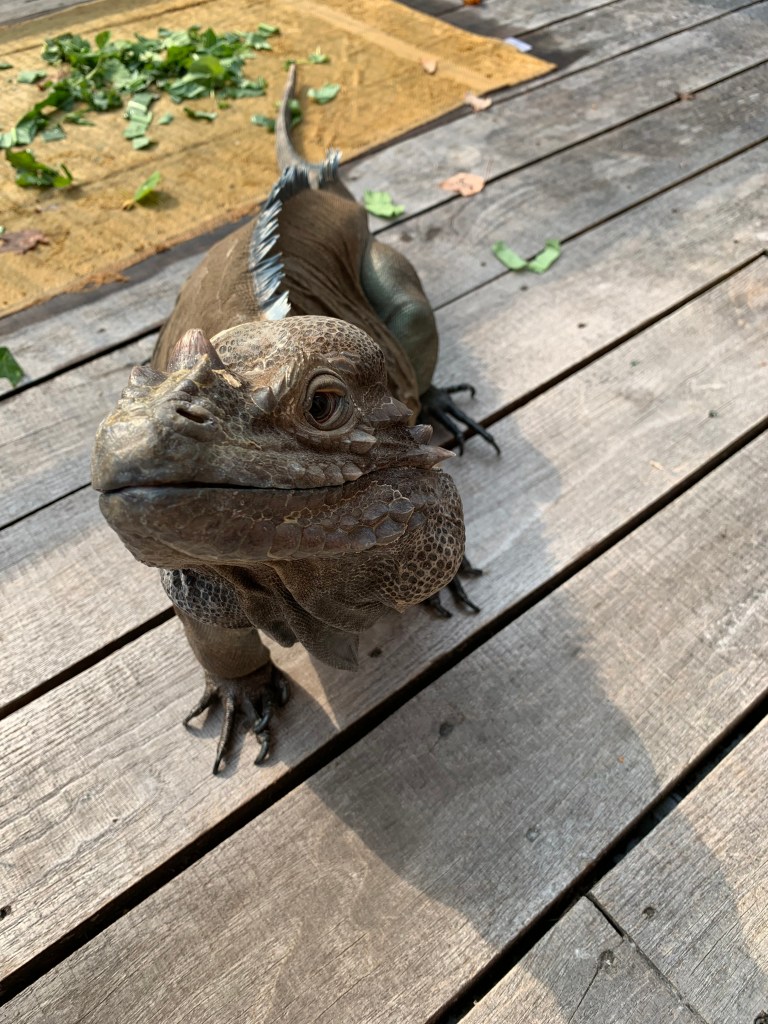
Sebastian’s head was not much bigger than my thumb and he fit in the palm of my hand with his wispy tail hanging down. I counted his ten toes and his ten fingers, each with a tiny, curved claw at the tip. His bellybutton was easy to see –a small line between the scales where the umbilicus to the yolk sac had been connected when he was inside the egg.
Sebastian was wary of motion and shadows. When a crow flew by out the window, he flinched and scrambled for a place to hide. He was so little and quick that he might slip out of the cage and go missing or be hurt by the cat. For his safety I put him in a small glass tank with a screened lid and a tree bark hut for hiding. I set the tank on the shelf inside the cage, with an extra basking light above.

Sebastian sat on his hide hut looking at objects in the room, noticing the spaces above the books on the shelves, and the dark doorway to the closet. He learned to recognize me quickly. Every time I walked in the room his shiny gray eyes peered into mine to discover my status –was I calm and safe, or agitated and dangerous? He learned the sound of my voice, my smell, and the way I moved. If a stranger entered the room, he crouched and made ready to flee, until he learned that the person was not a threat.
Rock iguanas need to eat a variety of green plants, and flowers and berries that are seasonally available. In their wild habitat iguanas are free to forage for plants that grow naturally. I studied the nutritional guidelines and the iguana diet established by zoos and private breeders and considered how I could provide my iguanas with the most nutritious diet.
At the supermarket, the greens were okay,but not super-fresh, and there wasn’t much variety. But in the yard around the barn, wild dandelion greens were coming up. At the edge of the yard, yellow flowers like dandelions and tender green shoots and leaves were pushing up through the soil. In the field guide to edible wild plants, I found the yellow flowers and leaves that were called colt’s foot. It tasted like a cross between spinach and lettuce. And just beyond the colt’s foot grew a weed called garlic mustard that tastes exactly like its name. Mustard greens were on the zoo’s list of foods for iguanas.
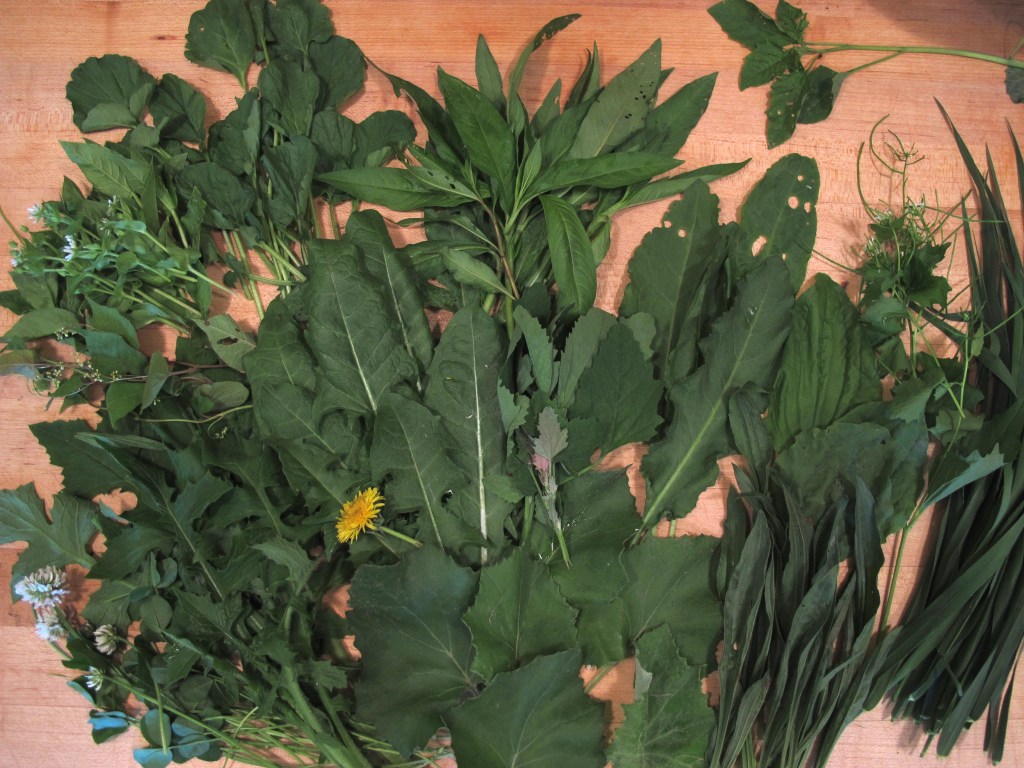

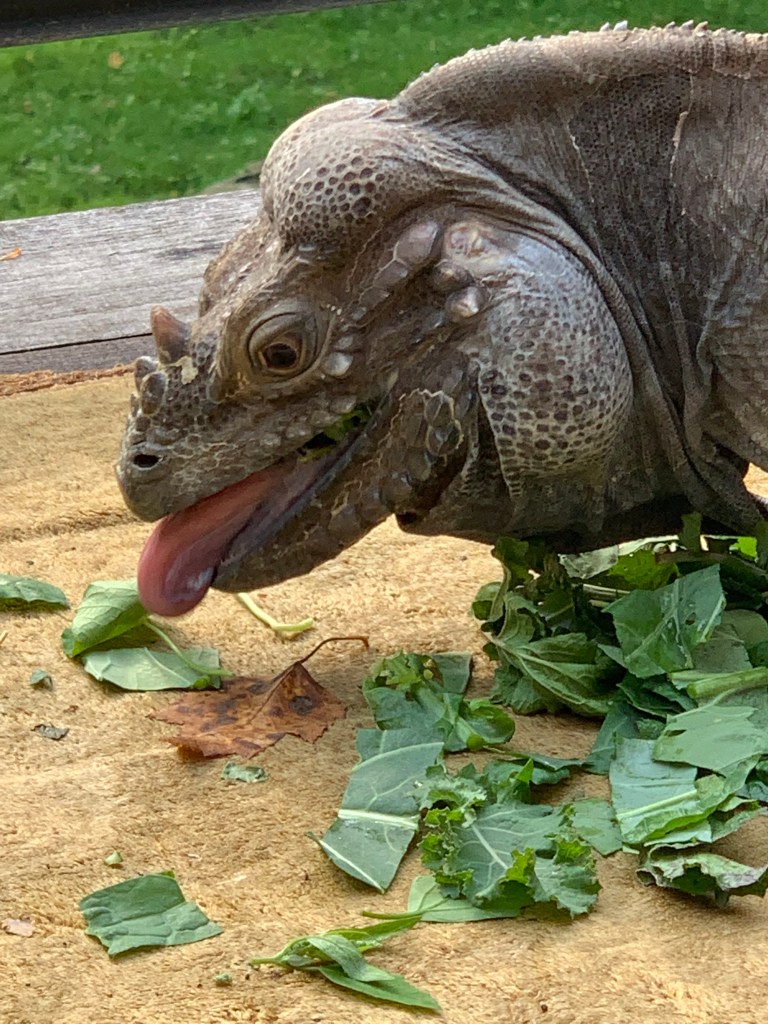
As spring turned to summer, I learned to identify many wild plants growing in the yard and field that were safe and nutritious for iguanas to eat. Also, I planted nasturtium, arugula, and turnip seeds, and bought collard greens and blueberries at the farmer’s market. I made salads for the iguanas that included at least five different kinds of greens and weeds, and flowers like violets and wild roses and nasturtiums. While blueberries were in season, the lizards ate them every day.
Baby rhinoceros iguanas grow fast. In about six weeks Sebastian had grown as big as Luna and Che. I took the lid off his tank and arranged branches for him to climb in and out. The three young lizards were not sexually mature, and they did not yet recognize each other as male or female, or as different species They ate and napped and played together. Every morning they woke at sunrise and chased each other up and down the screen, making a racket with their claws.
Both Luna and Che let me slip my hand underneath their bellies and lift them up to hold and pet. Sebastian scurried away from my hands, but not because he was afraid, he just did not want to be caught and held. He liked being free to explore. How could I teach him to let me handle him, without harming his wild spirit? Big rhino iguanas can give bad bites and I did not want him growing up angry with me. My relationship with Sebastian had to be built on trust and respect.
If Sebastian was inside his hide hut, I didn’t go after him, since –like all reptiles—he had a good memory and would remember if I did not respect him. When he came out and sat on top of his hide hut, I offered him a piece of mango, which he ate, and then I rested my palm on top of the hut in front of him. He bent down and bit the top of my hand. His bite felt like a prickly pinch. He bit again, with all his little might, but the hand would not go away, and he gave up. That day, I did not try to pick him up. It was important that he not feel too powerless.
The next day I fed him some more mango pieces and then eased my hand under him and stroked his chin with my thumb. Soon he got used to my hands. He also learned that I could give him a ride to places outside the cage, like the bed with its soft cover he could scurry across, and the bookshelf he could climb and perch on for a different view of the room, and everything in it. Looking at objects and exploring his world fed his curiosity.
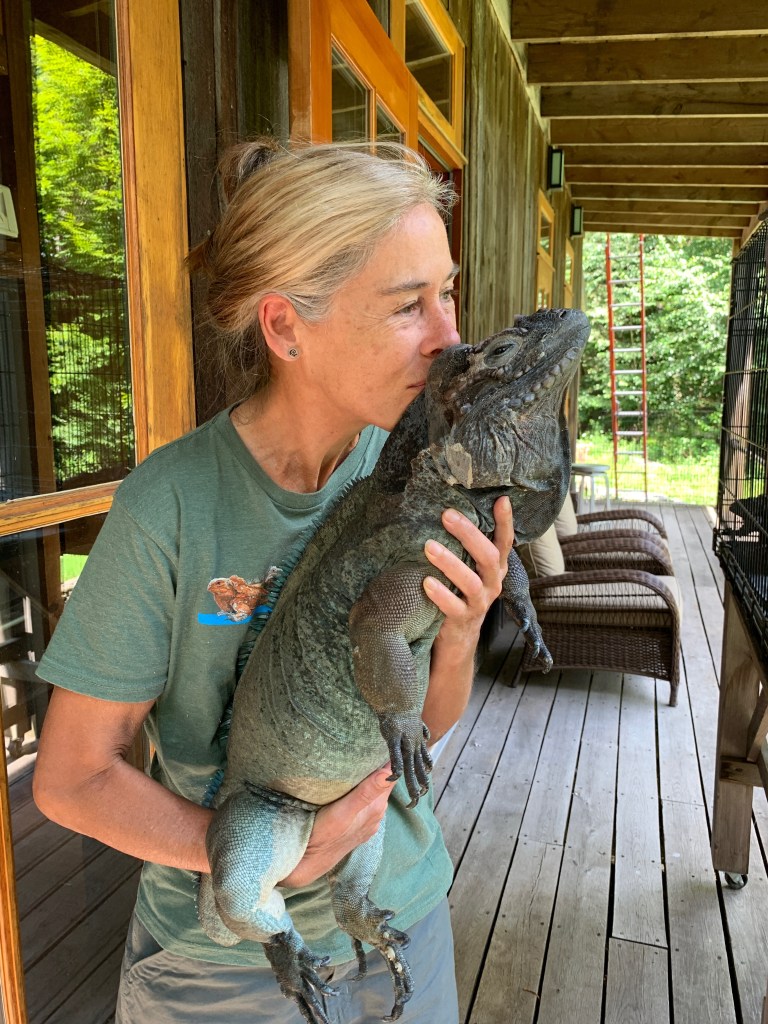
I rarely grasped and restrained Sebastian, but let him climb onto my hand, and he would run up my arm to sit on my shoulder. When he was near my face, I talked to him so he could see my mouth move and feel my breath and hear my voice up close, and one day I kissed him on his shoulder, to show him that kissing was a harmless thing I would do sometimes.
Sebastian grew up
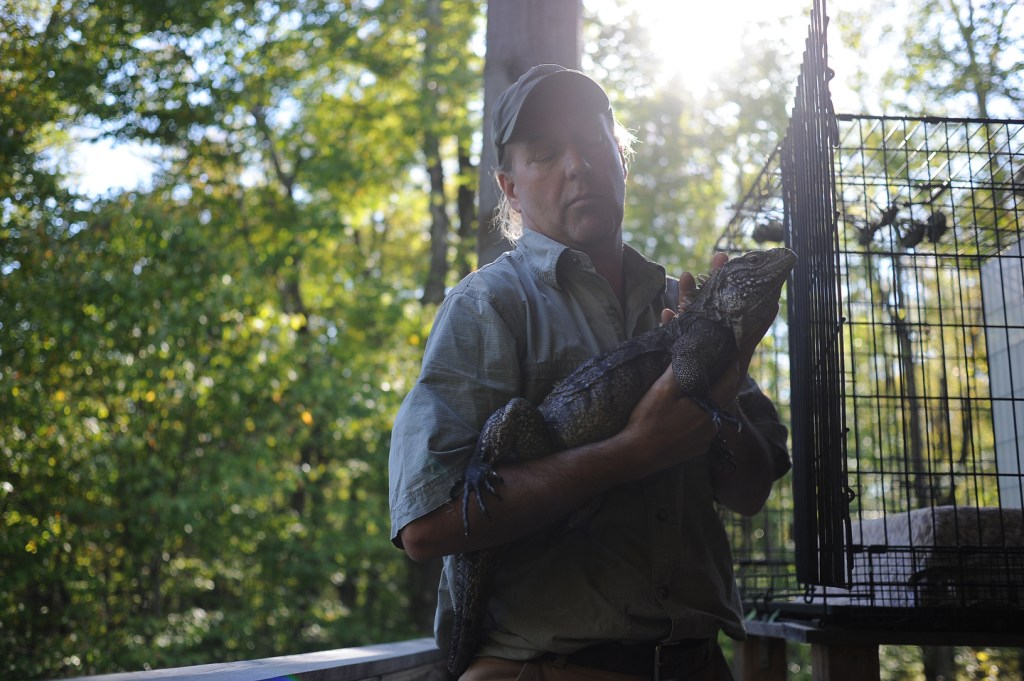
Sebastian is twenty years old now, and we all live in a bigger barn, close to the old one. Emo and Ava have been with us eighteen years and they are the same age.
When I hold Sebastian in my arms, he is my big baby. His legs hold onto my waist, his arms rest on my shoulders and his tail reaches my knee. He doesn’t like to be restrained, he wants to get down and go exploring. We have a good time together when I just sit down on the floor with him –then, he hangs out with me. He likes to climb onto my stomach when I sunbathe on the deck. Social basking with my rhinos is as close as I can get to being a lizard.
Soon after moving into the new barn, we learned to never leave socks on the floor. One time Sebastian ate a wool sock, which had to be surgically removed. Here’s how I figured it out: a) there was only one sock hanging on the drying rack, b) his belly was the size and shape of a football, c) he was back-striking with his arm, which meant that he had a tummy ache. I loaded him into the truck, and we drove up to Ithaca, to the Cornell Veterinary Hospital.
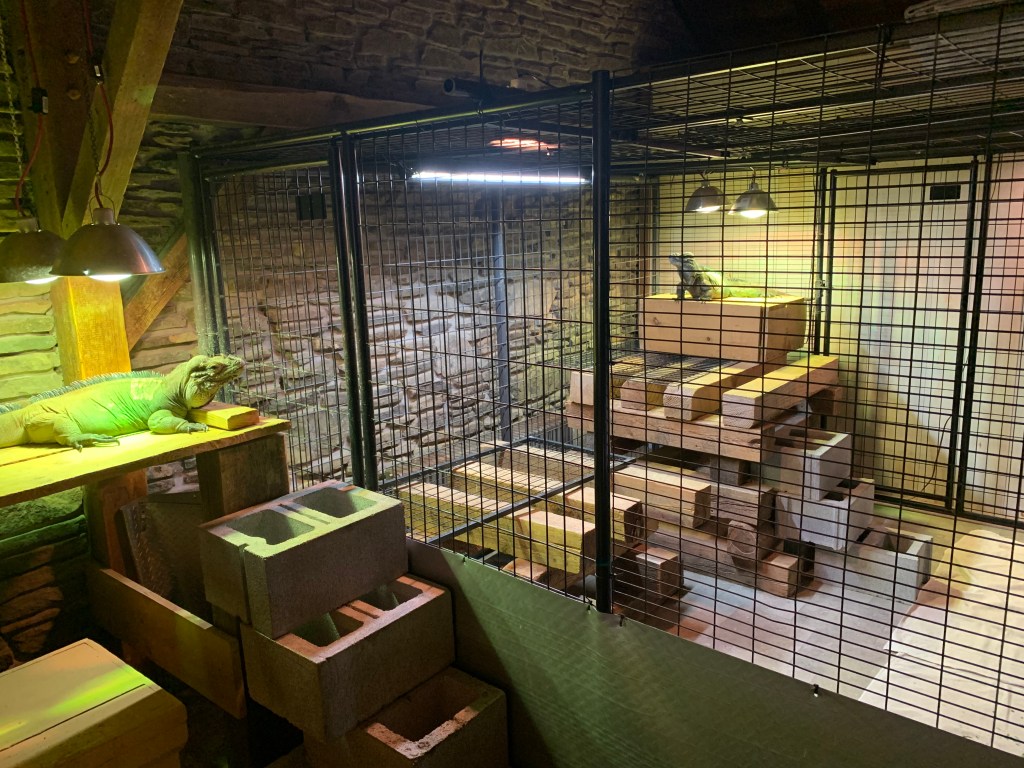
Emo’s corral is built around one of the barn window dormers and looking at the photo, it is to the left, behind the camera. Emo can sit on his basking place and see Ava and Sebastian, and he can see into the woods.
Ava’s basking place is on top of her hide box, and she climbs the cinderblocks to get up and down. When the lizards are on their basking places, they can see each other. Every morning they talk to each other with their eyes and head movements. Soon Ava climbs down her ladder and walks her dinosaur walk –kathump-kathump-kathump—past Sebastian’s cage, around the corner, and down the hall to the deck. In spring and summer, the doors are open, and Ava goes out in the sun and rests her belly on the warm boards and stretches out her arms and legs. There are two big dog kennels on the deck, one at each end, and inside them are basking shelves and shaded places. When Emo and Sebastian sit on the high shelves in their sunning cages, they see into the treetops in the woods that surround us. I carry the two males out separately to their sunning cages so they cannot fight with each other or try to herd Ava.
Biological Imperative
Sebastian’s biggest desire is to show Emo who is boss, and to herd Ava. It is a biological imperative that’s built into his genes, and it is for the survival of his species.
Emo and Ava have biological imperatives too, but Sebastian’s is the strongest. When I give my lizards breakfast on the deck, Ava and Emo dig in, while Sebastian nibbles and then climbs the cage door, trying to see what the other two are doing. “Eating breakfast,” I tell him. “That’s what you need to do.”
I go inside Sebastian’s cage and pick him up and put him on a basking shelf so we can have a talk. I stand there with the food bowl, and I say, “Sebastian,” and he boosts himself up like a cat, his nose and tail in the air. I stroke his back and around his jowls and he shuts his eyes. After a few minutes of petting I say, “Sebastian. Please eat, so you can grow big, like your granddaddy.” I have a picture of Mao in my head, and I hold food in my hand. And then, Sebastian does eat. Not because he understands my words, but because he has learned that this interaction is about eating. Still, Emo and Ava finish their breakfast, and often Sebastian does not, because he is so preoccupied by his biological imperative. It is sad and funny, because Sebastian thinks he’s the boss, but Ava and Emo are bigger than him.
When the sun is low in the sky, Ava leaves the deck and walks down the hall, around the corner, and goes up the ladder to her hide box. I carry Emo back to his corral, and then I open the door of Sebastian’s sunning cage. He comes out tongue flicking and searching for the others. He sees that Emo is not in his sunning cage, and he follows Ava’s trail down the hall, past his cage and he stops at the bottom of her cinderblock ladder and looks up. She looks down at him and shake-twists her head, saying, “No.” Sebastian starts climbing the cinderblocks and Ava opens her mouth wide, shake-twists her head, and hisses. Before he gets too close, I lift Sebastian up and carry him inside his cage. We look at each other and I say, “I’m sorry, ‘Bastian.”
The problem with living with big lizards in captivity is that I can’t always let them do what they want. In their natural habitat in the Dominican Republic, there is plenty of room for a lizard to flee from battle, or to retreat down in his burrow. Here in the barn are walls, and glass to crash into and it is not safe to let them chase and engage each other.When I block Sebastian’s biological imperative, I frustrate him.
So, what do I do?
Sebastian needs activities. We play a game in the morning before Ava comes down her ladder, or in the afternoon, when she returns to her hide box. Sebastian climbs down from his basking place and waits by the gate, while I get his sweater that hangs from a beam in easy reach for me. Sweater’s sleeves are tied in knots and it’s shreddy, with dried lizard spit all over. (I pull off the loose bits, so he doesn’t swallow them.) I open the gate and start down the hall, dragging Sweater by one sleeve and Sebastian follows. I look over my shoulder and see him run faster, thump-thump-thump on the rug, with his tail in the air, swishing side-to-side and I get a thrill that a small dinosaur is chasing me, and I run and hurry to open the door to the deck and step quickly around it. I dangle Sweater and Sebastian grabs the knot on the sleeve and shakes it like a dog with a chew toy. He chews Sweater and bites down hard and I hear his teeth chomp and mesh, and I watch the powerful muscles around his head and jaws.
After Sebastian defeats Sweater, he poops on the deck. It is dark green and not very stinky, but grassy, sort of like sheep poop. If the sun is out, I scoot him into his sunning cage. In the winter, he chases Sweater and gets it on the rug just inside the deck doors. He poops on a towel, and then he wants to explore. He goes part way down the stairs to eat some of the aloe plant on the landing by the window. I keep five aloe plants in pots and when one has been nearly destroyed, I replace it with one that has re-grown, and I let the damaged one recover on a windowsill.
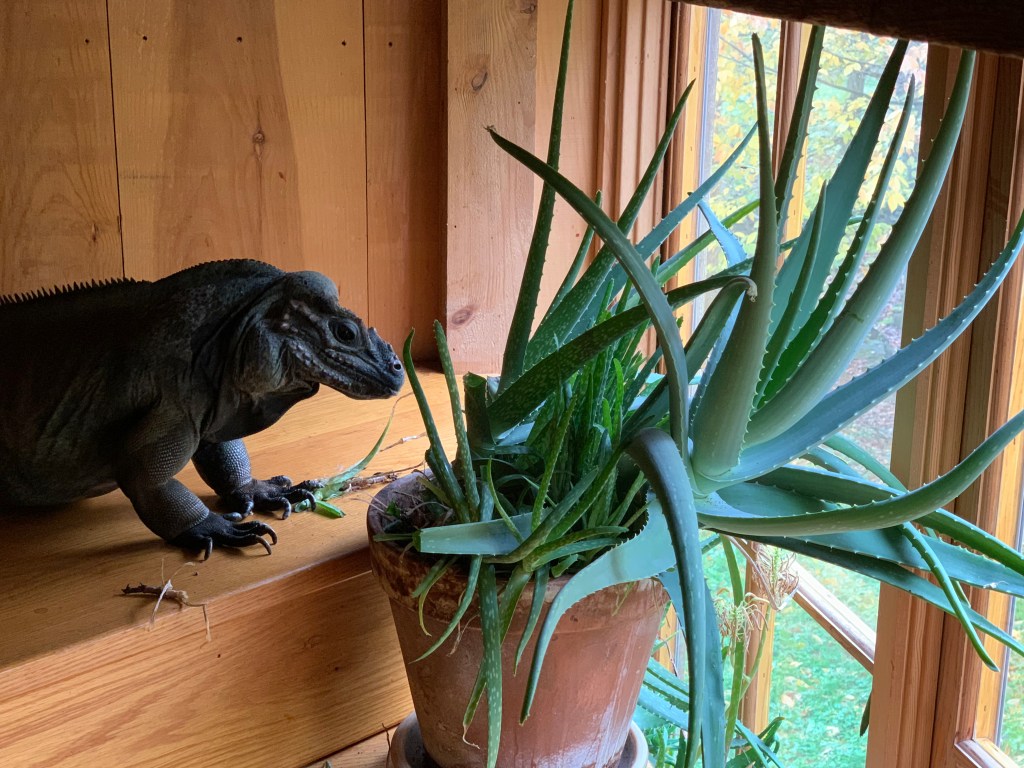
Sometimes I bring Sebastian the rest of the way downstairs to explore while I am cooking. He comes to the kitchen and tries to eat the cat’s food, and gets a fruit treat instead. He climbs into the cabinets, and clatters pots and bowls and I coax him back out. He goes in the living room and climbs up on the couch and that’s fine, until he starts looking up at the lamp and the painting on the wall. I put him back down on the floor and he goes poking around by the boots near the door. After a while, Sebastian goes back up the stairs. He doesn’t want to be away from his territory for long. When he gets to the top, he looks across the middle bay to the other side of the barn to see if Ava is on her basking place. He explores the bedroom, tongue-flicking where Ava has been. He goes in the closet, where Ava sometimes burrows under the sheets and towels and falls asleep. He explores where Ava doesn’t go, behind the sweater chest and on top of the books. Sebastian is engaged in SEEKING behavior, and this helps him with boredom and frustration.
Iguanas have social and biological drives, and they need to come out of their enclosure every day for runabouts, to keep their digestion healthy and to alleviate boredom. In Temple Grandin’s book ANIMALS MAKE US HUMAN, she talks about what captive animals need to be happy. The same things, mostly, are true for iguanas. Grandin says, “…the more freedom you give an animal to act naturally the better, because normal behaviors evolved to satisfy core emotions…if you can’t give an animal the freedom to act naturally, then you should think about how to satisfy the emotion that motivates the behavior by giving the animal other things to do.”
If they can’t go outside, the iguanas take turns roaming and SEEKING upstairs and down. The barn’s heat system is radiant, and the floors are warm.
Lizard Love
When I have time, I go into Sebastian’s cage and sit down beside him and right away, I feel especially happy. I sit there, adoring his scaly lizardness. We look into each other’s eyes. Sebastian can sense emotion. One day, we were sitting together, and he started watching my braid that was hanging down, and in the next moment, he had it in his jaws. He did not shake it the way he shakes Sweater, he held on, the way a male iguana bites and holds a female’s neck when they mate. I rested my hand on his head and I pulled gently on my braid. He let go, and I tucked the braid back in the barrette. Later, I brought him some blueberries since they are one of his favorite treats.
Sebastian recognizes me as female, and sometimes he tries to herd me. When I am making the bed, or folding laundry and forget that I am wearing gray pants, I hear his claws clicking the floor, moving fast and see him coming at me. I say, “Sebastian!” and reach down and scoop him up to remind him that I am not a lizard.
Time for bed
Some days I must leave the barn to work, and Sebastian does not get to come out of his cage. He goes inside his hide box and sulks. When I come home if it’s not yet dark, he hears my voice and I hear him climbing out of his hide box. I go upstairs and see the breakfast he didn’t eat. “Sebastian,” I say, “you are a terrible lizard!” (That’s what “dinosaur” means.) He boosts himself a little, as though to say, “I’m a good boy.” He climbs down to wait by the cage door, and I get Sweater and he can chase and get it while I change out of my work clothes.
As the sun sets, I carry him back to his cage, and settle him on his basking place. He blinks, and his milky-white nictitating membrane is slow to retract and gives him sleepy-baby eyes. His lights go off. Some nights he climbs down into his hide box to sleep and other nights he sleeps on top. Sometimes I hear him scratching a bit of loose skin. Thonk-thonk-thonk, against the inside of his box, he scratches with his back foot like a cat. But mostly, he sleeps sound all night.
Luna and Che
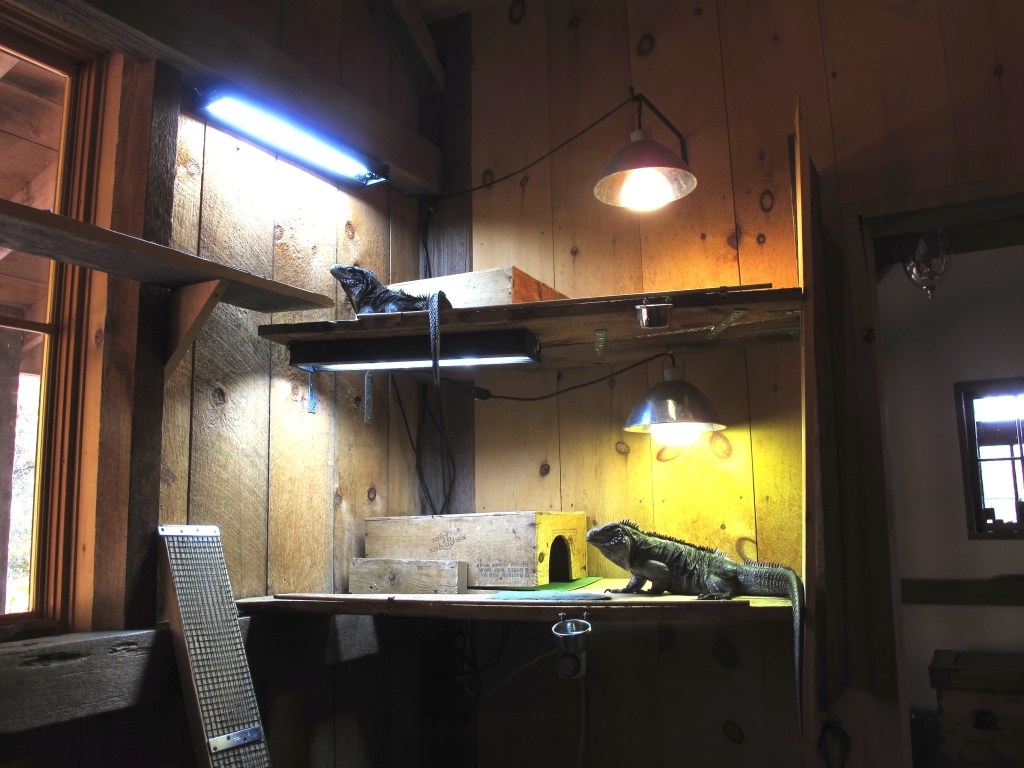
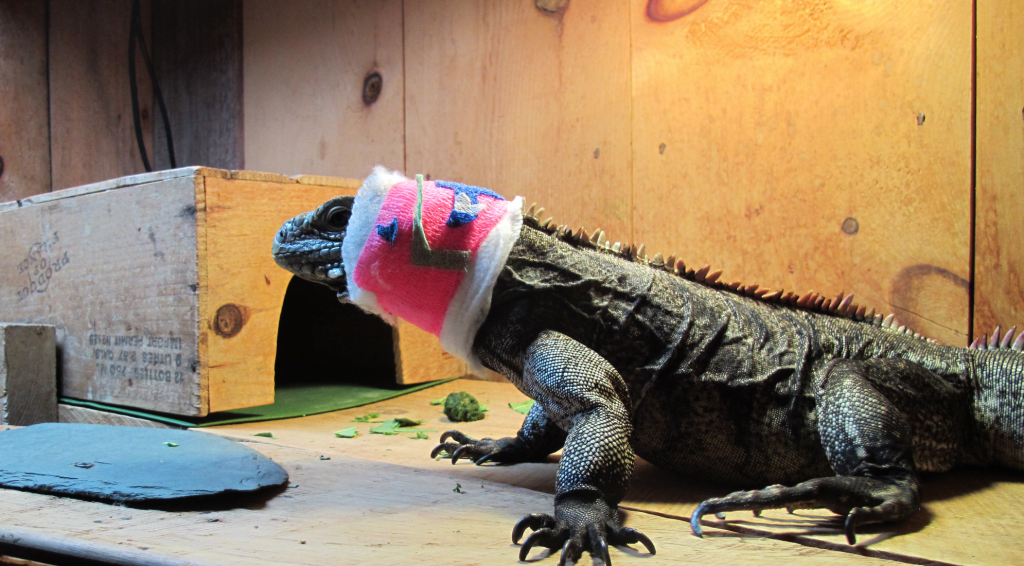
Now, Luna has the mud room to herself. It has a gate to keep her from exploring when we’re not home. The slate floor has radiant heat, and there’s a big window she can look out to keep an eye on who’s coming and going, including deer and squirrels and birds. Most mornings Luna comes down her “ladder” and waits at the gate to come out. Sometimes we roll blueberries across the floor, and she chases them.

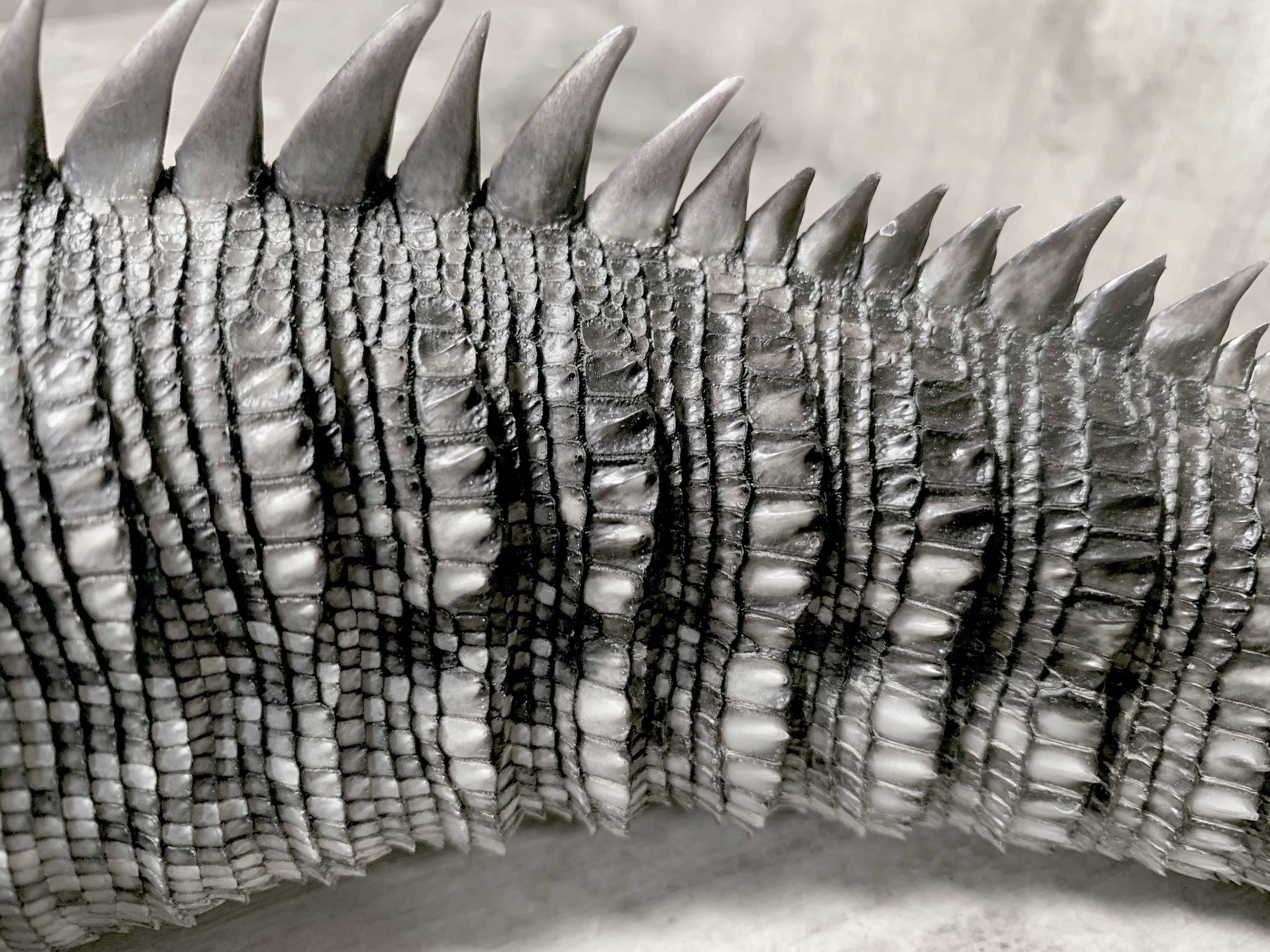
I love this photo of Che, where you can see his Cyclura tail rings. Cuban iguanas, rhino iguanas, and Jamaican iguanas and all the West Indian rock iguanas are cousins. They are all species of the genus Cyclura, which means “circle-tailed lizard.”
The barn faces south-east and there are sunning cages outside. On the upper deck are 6 x 10 dog kennels for the rhinos. Che and Luna have smaller cages on the lower deck. By mid-February, we’ll start getting sunny days –no clouds, no wind—and the lizards can go out on the decks for an hour. By April they can be out almost all day and I put up shade tarps, so they don’t overheat. When Che and Luna are in their sunning cages, they bob heads at each other and make faces.
Lizard Food
In winter I go to Willow Wisp Organic Farm to pick rye grass, which is a cover crop that stays alive in the frozen ground under the snow. When I brush off the snow and pick it, I can smell the fresh greenness. There are other greens in the Zephyr, like spinach mustard, arugula, bok choi, turnip, and chickweed.
A couple times a week I make a mash in the food processor of rye grass, chickweed, collard stems, and a mix of dried plants. Sometimes I add some winter squash, like butternut, or pumpkin. Once the grass and dry plants are all mixed, I add some pre-soaked dried mango (or fig, or papaya, un-sulphured and without sugar) and blend to a consistency that I can form with my hands into egg-shaped balls. Each lizard gets 2-4 of the balls and then, the regular salad of coarsely chopped greens –collard, arugula, totsoi, turnip, and watercress when I can get it. Making this mash ensures that each lizard gets a complete, balanced meal since they can’t pick out their favorite bits. I don’t wash what I pick, because the soil clinging to the leaves and stems is full of nutrients.
The organic dried plants come from FRONTIER, and I make my own mix, using nettles, hibiscus flower, and dandelion. Alfalfa is good for iguanas, but mine hate the taste and refuse to eat it.
In the spring and summer, I also make a mash in the food processor. I don’t add the dried plants when I’m getting fresh ones. I aim to get 5 or 6 different kinds of wild plants in their mixes. In March, I start finding winter cress, garlic mustard, a species of chickweed, and as the spring gets warmer, colt’s foot, and soon after, dandelion leaves, and wild lettuces, and blackberry, raspberry, and wild rose shoots. Yellow dock will push up from thawed ground, and narrow-leaf plantain, which has survived ice and snow. By summer, there will be lamb’s quarters, lots of dandelion, wild amaranth, clover, smartweed, purslane, and others to add to the mix. I have a Field Guide to Wild Edible Plants. Each year I learn about new plants to add to the iguanas’ diet. It’s not scientific, but I always taste the plants. When winter cress blooms it is very bitter, and the lizards don’t seem to like it. There are just a few dangerous plants, like deadly nightshade, and dog’s bane.
Dreaming
On a hot summer day in Florida, during one of my visits to Bob’s place I sat on the ground inside a pen Bob called “Hispaniola” (the Dominican Republic), where rhinoceros iguanas basked in the sun like a gathering of dragons.
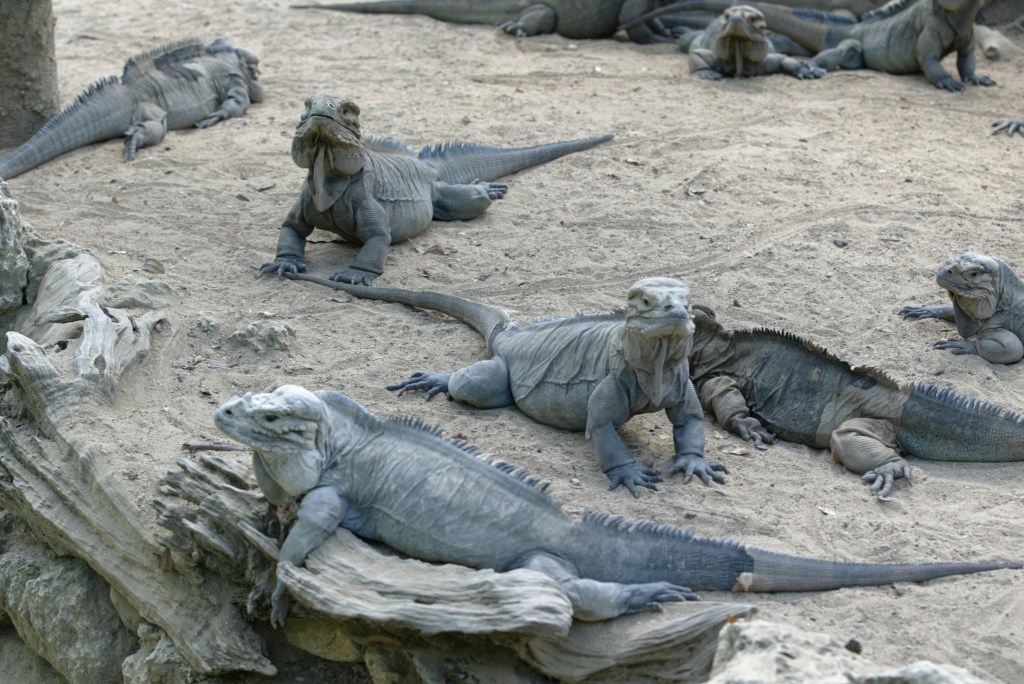
At first, there didn’t seem to be much going on. But they were having a lizard conversation by giving each other looks with their eyes and making head movements and body gestures. The males had bigger heads and fat jowls. One tossed his head, like a nod, then twisted it side-to-side and another narrowed his eyes and answered, twist-shaking his head. One female gave a nod and a head-toss, and one rested her chin on another’s back and shut her eyes as though bored with the conversation. One female stood up and walked toward me, her long tail out behind, hips moving side-to-side. She sat down close enough to touch and tilted her head to look in my eyes. We looked at each other for a while. I reached out to pet her scaly back and sides and she closed her eyes. After a few minutes she got up and walked back to be with her people. I wanted to go with her. I will always long to go be with lizards in their home. But here in the barn in the Catskills, with Mark and our five iguanas, life is good. Really good.
 Lizard Lady